Precision Access for Food and Beverage: Multiplying Safety and Performance in High-Output Processing Facilities
December 22, 2025
Food and beverage processing plants run on tight margins where every minute of downtime has a dollar value. Conventional ladders and temporary scaffolding introduce fall hazards, slow maintenance cycles, and create bacteria-trapping surfaces that conflict with food safety standards. Modular, engineered work access systems address all three problems at once, meeting OSHA, ANSI, and ADA requirements while surviving the aggressive washdowns these facilities demand daily.
Key Takeaways:
- Ladders and temporary scaffolding are not neutral choices in food processing environments. They create fall risk, slow down maintenance work, and introduce hygiene liabilities that modular platforms are specifically designed to eliminate.
- Matching the right engineered solution to each specific hazard, whether wet floors, overhead pipe networks, or open-edge tank access, is more effective and defensible than applying a one-size-fits-all approach to fall protection.
- Modular systems built from anodized aluminum or hot-dipped galvanized steel can be reconfigured as production lines change, protecting the capital investment while keeping safety infrastructure current with facility requirements.

Faster Food: Why Modular Access is a Performance Multiplier
The U.S. fast food industry generates more than $331 billion in revenue annually, and the average American spends about $1,200 per year on such fare. With good reason. Fast food means speed, reliability, and easy access. You know what you are getting. It is served quickly and conveniently.
“Faster food” is what happens behind the scenes in the demanding, high-stakes environment of food and beverage processing plants. From mixing and fermentation through cooking, cooling, and high-speed packaging, these plants are complex, multi-stage systems where equipment uptime is inseparable from worker safety.
Every minute of unplanned downtime is a financial setback. Yet, the pressure to maintain output cannot compromise employee well-being during essential maintenance and inspections, especially when working at height.
In these facilities, fall protection systems must not only be robust and compliant but also coexist with rigorous hygiene standards. Safety solutions must be as easy to clean as they are safe to climb. Modular, military-grade work access systems are needed to replace outmoded ladders and scaffolding to “multiply safety and performance.”
Phase 1: Identifying the Access Gap
Conventional access methods like ladders and temporary scaffolding are operational bottlenecks. They introduce significant risk and inefficiency into the production line.
The Problem with Ladders – There are several hazards and inefficiencies when workers use ladders to inspect large mixers, kettles, or cookers. Ladders can easily tip on wet or greasy floors. They offer limited access and need to be repositioned frequently. The “three points of contact” rule leaves a technician with only one free hand to perform complex tasks. The work takes longer, increasing the risk of fatigue and injury.
Solution: Custom-engineered Work Platforms.
- Features anti-slip, self-draining walking-working surfaces.
- Provides a secure, stable base, whether a static (fixed) structure or fitted with total-lock casters for mobility.
- Integrated guardrails offer added fall protection.
- Enables hands-free, two-handed work, significantly increasing both safety and task efficiency.
- Supports higher load capacities for multiple workers and larger areas for ergonomic access.
- Can store tools and parts – another boon for efficiency.
The Scaffolding Efficiency Drain – Erecting temporary scaffolding to reach overhead cooling, sterilization, or conveyor systems creates multiple problems. The assembly and teardown process consumes valuable time, blocks critical production aisles, and creates hard-to-clean “nooks and crannies” where bacteria can accumulate, compromising food safety.

Solution: Modular Stair Systems and Crossover Bridges.
- Modular design offers quick, easy assembly without welding or drilling.
- Systems provide clear, compliant, rapid access to workstations.
- Production floors are unobstructed.
- Hygiene standards are maintained.
Phase 2: Mapping Hazards to Engineered Solutions
Safe, productive work access requires matching specific, common hazards in food processing plants to precision-engineered controls.
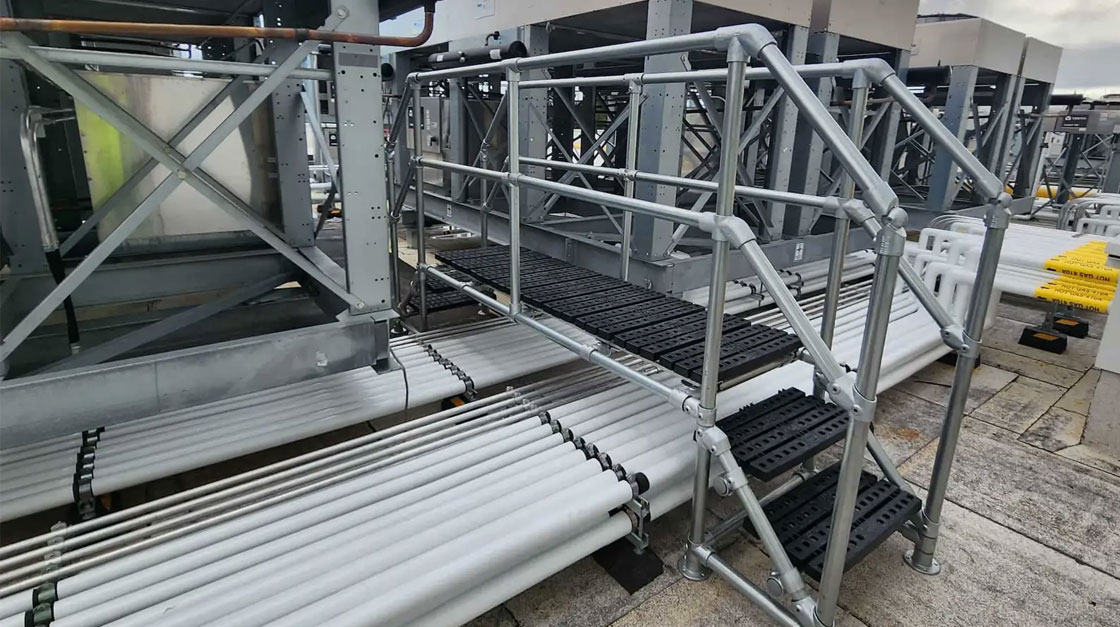
Hazard: Navigating the “Pipe Jungle” – Workers servicing HVAC and refrigeration units on the rooftop or near the ceiling often must navigate over or around a maze of pipes and utility lines.

Solution: Fixed Crossover Platforms
- Creates a dedicated, OSHA-compliant bridge over obstructions.
- Features anti-slip, self-draining treads, and integrated guardrails.
- Safeguards workers from slips, trips and falls while preventing damage to sensitive utility lines.
Hazard: Servicing Generators, High-Vat Mixers & Fermenters – Servicing generators, inspecting or sampling inside large tanks often requires work at height access or leaning over unprotected edges, creating a clear fall hazard.

Solution: Work Platforms and Safety Gates
- Work platforms fitted with a self-closing safety gate create a fully enclosed, secure perimeter.
- Gates feature a spring-loaded mechanism to close automatically behind the user, eliminating human error.
- Ensures compliance with OSHA 1910.28 fall protection requirements for hazardous edges.
Hazard: Slips on Wet Production Floors – The high-moisture environment of cleaning and sanitizing washdown cycles in meat, dairy, and beverage plants creates persistent slip hazards.

Solution: Patented Safety Tread
- Constructed of high-strength, corrosion-resistant anodized aluminum or glass-reinforced nylon.
- Omni-directional for flexible installation, anti-slip safety, and non-bounce stability.
- Self-draining feature ensures sure-footedness for workers, even on surfaces wet from aggressive cleaning or food processing residues.
The Compliance Standards: OSHA, ANSI, and ADA
In food processing, regulatory compliance and rigorous protocols are non-negotiable for all aspects of operations. Off-the-shelf safety solutions often fail to meet exacting standards, leaving facilities vulnerable to violations and fines.
OSHA & ANSI Precision – FlexDecks components are precision-built to OSHA-specified sizes (e.g., 42-inch guardrail heights) and load ratings (200-lb. force applied anywhere along the top rail) to provide 100% regulatory certainty.
ADA Accessibility – For facilities requiring public access or specific ergonomic considerations, modular ramps and stair systems are engineered to meet ADA slope and width requirements.
Military-grade Durability – Material selection is equally critical for longevity and food safety. The use of anodized aluminum and hot-dipped galvanized steel provides exceptional strength and corrosion resistance. Guardrails, platforms, stair frames, and safety gates withstand the aggressive chemicals and high-pressure sprays used in food-grade sanitization.

The FlexDecks Difference: Modular Efficiency
Modular access systems are inherently flexible and efficient, which directly support a facility’s operational agility.
Rapid Deployment – Using prefabricated components, systems are installed with minimal disruption to production areas. No welding, no sparks near sensitive equipment, and no drilling is necessary.
Adaptable Agility – As production lines evolve with new products or plant layouts, modular systems can be disassembled and reconfigured to fit new requirements. This adaptability protects your capital investment and maintains your safety infrastructure.
A Legacy of Performance – Founded in 1989 and now backed by the global engineering expertise of the Kee Safety family, FlexDecks brings more than 35 years of specialized engineering expertise to the most demanding industrial and military environments.
Order a Full Serving of Safety—Fast!
In the food and beverage industry, safe access is the foundation of operational uptime and workforce protection. Transitioning from improvised ladders and temporary scaffolding to engineered modular platforms is more than a simple safety upgrade—it represents a strategic performance multiplier that bolsters productivity, ensures regulatory compliance, and coexists with rigorous hygiene protocols.
Is your facility still relying on risky, improvised access for critical maintenance tasks? Contact the experts at FlexDecks at (346) 998-0200 or visit flexdecks.com to schedule a consultation and see how a precision-engineered access solution can multiply safety and performance for your food and beverage operation.
Frequently Asked Questions
Q: Why are standard ladders a compliance risk in food and beverage plants specifically?
A: The risks go beyond general fall statistics. In processing environments, floors are frequently wet or greasy, which increases tip-over risk significantly. Beyond that, the three-points-of-contact rule leaves a technician with only one free hand, making complex maintenance tasks slower and more error-prone. Longer task times mean longer fatigue exposure. Engineered platforms with guardrails and self-draining surfaces remove these variables and give inspectors and maintenance crews a stable, two-handed working position.
Q: How do temporary scaffolding setups create food safety problems, not just fall hazards?
A: Scaffolding frames and connectors create recesses and overlapping surfaces that are difficult to clean thoroughly. In a facility operating under HACCP protocols or third-party audits, those hard-to-reach areas become potential bacteria harborage points. Modular stair systems and crossover bridges, by contrast, use open, self-draining designs that hold up to high-pressure washdown procedures without trapping residue.
Q: What does OSHA 1910.28 require for open-edge work at height, and how do safety gates address it?
A: OSHA 1910.28 covers fall protection requirements for walking and working surfaces, including any unprotected edge or side where a worker could fall four feet or more in general industry settings. A self-closing safety gate on a work platform creates a continuously enclosed perimeter. The spring-loaded mechanism means the gate closes automatically once a worker passes through, removing the human error factor that a manually latched gate introduces. This is particularly important near large vats, fermenters, and mixers where workers may be carrying tools or samples.
Q: Can modular access systems realistically keep pace with a processing facility that retools or expands its production lines?
A: Yes, and this is one of the more practical arguments for specifying modular over custom-welded or poured-concrete solutions. Because modular components are prefabricated and connect without welding or drilling, they can be disassembled, moved, and rebuilt in a new configuration when equipment layouts change. For a facility adding a new packaging line or relocating a mixing station, this means the existing safety infrastructure does not become a write-off. It adapts instead, which matters considerably when capital budgets are under pressure.