Safe, Compliant Access for Building Services: Elevating Maintenance on Heavy Equipment
Modern rooftops and ground-level equipment pads host chillers, HVAC units, generators, cooling towers, and transformer banks whose filter banks, compressor heads, pressure relief valves, and high-voltage disconnects require regular attention at heights and angles that standing reach cannot safely cover. When technicians improvise access by climbing onto equipment frames, balancing on narrow curbs, or leaning off portable ladders under time pressure or in bad weather, routine maintenance becomes the leading edge of a fall incident. Engineered modular access platforms convert those high-frequency hazardous tasks into repeatable, ergonomic, walk-up procedures that collectively protect every worker without placing the compliance burden on individual behavior.
Key Takeaways
- OSHA treats ladders as acceptable for short, infrequent tasks but not for recurring maintenance schedules. Once a task becomes part of a regular maintenance cycle, a fixed access solution is the preferred control because it collectively protects workers without requiring daily inspection logs, proper setup verification, or three-point contact compliance from the individual technician.
- Rooftops and ground equipment pads present distinct but equally serious hazard profiles. Rooftops expose technicians to unguarded edges, slippery biological growth, fragile membranes, and wind exposure. Ground pads present conduit runs, fluid leaks, piping, and equipment vibration. Both environments reward defined access routes over improvised ones, and crossover platforms and step-overs are what create those routes without penetrating the roof membrane or requiring field welding.
- The financial argument for permanent platforms over portable ladders is a lifecycle cost calculation rather than a sticker price comparison. Ladders are inexpensive to purchase and expensive to sustain through inspection logs, compliance overhead, and the workers’ compensation claims and liability exposure that ladder-related falls generate. Permanent platforms carry a larger upfront investment that reduces cost per use and long-term liability across the full service life of the equipment they support.

Safe, Compliant Access for Building Services: Elevating Maintenance on Heavy Equipment
There may be no practical limit to the benefits of stretching. From the professional athlete to the beer league ball player, pre-game stretching is a ritual to enhance flexibility and avoid pulled muscles and other injuries. In our daily lives, it helps with stress, blood flow, back pain, and more.
There is, however, a limit on how far employees should stretch to reach filters, compressors, electrical panels, gauges, valves, and other components when working at height to inspect, maintain, or repair heavy equipment that supports a wide range of building services. This is where stretching becomes awkward and dangerous, especially when relying on ladders or makeshift scaffolds, which are inherently unstable.
Facility directors, HVAC maintenance supervisors, plant operations managers, real estate executives, and EHS/safety coordinators at commercial, institutional, and industrial facilities must evaluate their building envelope—from ground-level vibration and debris to rooftop penetration risks and uneven surfaces—for OSHA compliance gaps regarding walking-working surfaces, leading edges, and clearance distances from high-voltage or pressurized systems.
When workers must climb over obstacles, stretch, or try to balance their way into performing routine tasks, they are at risk of injury, especially from a fall. Engineered, modular access platforms for elevated work turn these hazardous chores into safe, ergonomic, walk-up tasks that comply with OSHA and reduce employers’ financial exposure.
The Reality of High-Frequency Maintenance on Heavy Building Assets
Modern rooftops are typically filled with an array of chillers, HVAC systems, remote terminal units (RTUs), solar panels, cooling towers, and exhaust fans. Ground-based installations add backup generators, transformer banks, and pump rooms into the mix. Such equipment requires constant attention to filter banks, compressor heads, sight gauges, pressure relief valves, motor belts, and high-voltage disconnects.
These maintenance reviews need to be conducted regularly, but many of the components to be inspected are positioned above standing height or in other hard-to-reach areas. A technician who climbs onto an equipment frame, stands on a narrow curb, or leans off a portable ladder to read a gauge will eventually do it under time pressure or in bad weather. That is how “quick checks” turn into operational bottlenecks and become major fall risks.
Rooftop vs. Ground-Based Challenges
The top-to-bottom building scenarios have different sets of hazards and constraints. Rooftops are like a dense rainforest. Ground pads are like an obstacle course.
Rooftops:
- Wind exposure
- Unguarded roof edges
- Slippery surfaces from moisture and biological growth
- Uneven walking surfaces
- Fragile roof membranes
Ground Pads:
- Conduit runs
- Concrete pads
- Piping
- Fluid leaks
- Equipment vibrations
Without a defined route, technicians improvise their own paths. Such unstructured movement leads to slips, trips, and awkward reaches into active equipment.
Engineering the Solution: Modularity Meets Ergonomics
Engineered safety systems featuring modular components deliver ergonomic solutions that safeguard workers so they can perform their tasks efficiently without risky stretching, reaching, or climbing.
Versatile Maintenance Platforms
These easy-to-assemble and reconfigure work access platforms create a dedicated, repeatable footprint rather than relying on a nearby work stand or a ladder. They feature wide platform decks that allow two (or more) technicians to work as a team with unencumbered movement around HVAC units, chillers, generators, and other equipment.
- Fixed (static) Work Platforms are ideal for permanent installation and frequent tasks.
- Mobile Access Platforms feature total-lock casters for station-to-station portability. Since crews can work hands-free, they are inherently safer and more efficient than ladders.
- Custom Engineered Platforms provide tailored solutions designed around complex equipment, geometries, and restricted zones. They can be fitted with racks and shelves for tool staging, fabricated for adjustable-height capability, or programmed with shop services, such as air, water, and electricity.
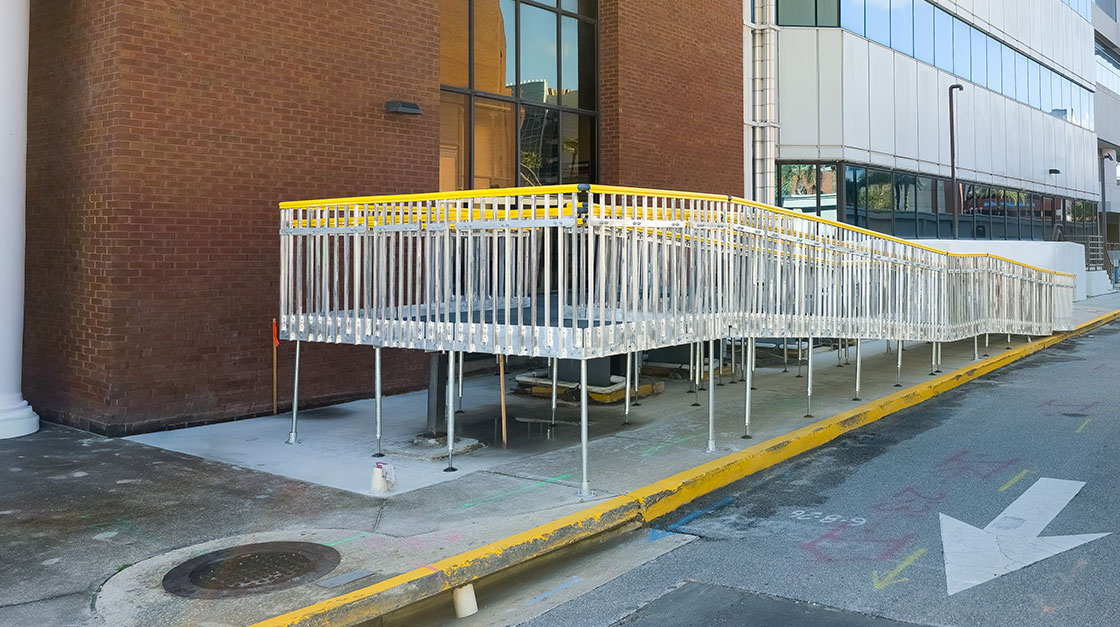
- Crossover Platforms & Step-Overs make sure crews get to their workstations safely, as they direct foot traffic and provide bridges over dense piping, cable trays, conduit runs, and other obstructions. They replace improvised paths with defined routes and take away the temptation for workers to climb over obstacles.
Material Standing
Built from high-strength, durable, and corrosion-resistant anodized aluminum and hot-dipped galvanized steel, these modular systems are installed or reconfigured without field welding or drilling. No hot-work permits are necessary, and there is minimal disruption to building operations; they are installed without penetrating the roof membrane. Anti-slip platform steps and decks are made of aluminum or glass-reinforced nylon, with grates for traction and to drain precipitation or spilled fluids.
Integrated Fall Protection
Across all systems, various features enhance OSHA-compliant fall protection:
- Handrails – Support and safety as workers traverse designated routes and climb/descend platform steps.
- Toe Boards – Continuous protection for dropped tools and equipment.
- Self-closing Safety Gates – Close and latch automatically once the worker passes through, guarding the opening.

Key Compliance and Risk Mitigations
OSHA 1910.23 and 1910.28 set clear requirements for walking-working surfaces, fall protection, and safe access to elevated work areas. Routine maintenance is easily within the purview of how these standards are intended.
- OSHA 1910.23 defines requirements for all ladders, including portable (1910.23(c)), fixed (1910.23(d)), and mobile ladder stands and platforms (1910.23(e)). A few pertinent regulations state that all metal ladders be corrosion-resistant and that mobile stands have a step width of 16 inches and casters that support a load proportional to four times the maximum intended load.
- OSHA 1910.28 details employers’ duty to have fall protection (at heights of 4 feet or more above a lower level in general industry). Among other aspects, it covers guardrails, toe boards, and stairways.
OSHA treats ladders as acceptable for short, infrequent chores, but once a task becomes part of a recurring schedule, a fixed access solution is preferred. Repeated ladder use requires inspection logs, proper set-up, and the burden of compliance (e.g., 3-point contact) on the worker. Once a platform is engineered and installed, workers are collectively protected without their active participation. Compliance becomes a matter of periodic inspection rather than an everyday duty.
Financially, ladders are relatively inexpensive, but costly to sustain. Falls from ladders, especially due to improper setup and use, are a major cause of workplace injuries. This increases workers’ compensation claims and other liability issues. Permanent platforms have a larger upfront investment, but they reduce the cost per use and typically decrease long-term liability exposure. Furthermore, the gains in efficiency, productivity, and worker satisfaction are far greater with platform systems.

Turn Equipment Maintenance into Walk-up Work
If your technicians are routinely climbing, stretching, or improvising their way to filters, gauges, and valves, that is worth a safety audit. Start with the equipment serviced most often. An engineered work access platform, supplemented by a crossover or step-over, will pay for itself faster and with reduced risk.
FlexDecks designs and builds modular, custom-engineered access solutions designed around exactly these conditions. Contact FlexDecks today to request a site assessment or platform configuration to turn your highest-frequency maintenance points into safe, walk-up work.
Frequently Asked Questions
Q: At what point does OSHA consider a ladder an inadequate solution for building equipment maintenance, and what does a compliant alternative look like?
A: OSHA 1910.23 permits ladder use for short, infrequent tasks but places the compliance burden squarely on the worker and the employer for every use: inspection before each deployment, correct setup on a stable surface, maintained three-point contact, and documentation of the ladder’s condition. When a maintenance task appears on a recurring schedule, those requirements become a daily administrative burden that compounds across a workforce. A fixed or mobile access platform removes that burden by providing collective protection. Once installed and periodically inspected, it protects every worker who uses it without requiring individual compliance decisions on each visit. For EHS coordinators managing maintenance schedules across multiple equipment zones, that shift from individual to collective protection is both a safety improvement and a significant reduction in administrative overhead.
Q: How do rooftop membrane fragility and ground pad obstructions create similar improvised access problems with different specific hazards?
A: Both environments share the same root cause: the absence of a defined, engineered path forces technicians to create their own routes. On a rooftop, improvised routes mean foot traffic on membrane surfaces that were not designed for repeated uncontrolled loading, which accelerates wear, creates puncture risk, and may void manufacturer warranties. On a ground equipment pad, improvised routes mean stepping over conduit runs, around piping, and through areas where fluid leaks or equipment vibrations are present at floor level. The incidents that result are different in character but identical in origin: a worker moving through a space that was never designed for the way they need to use it. Crossover platforms on rooftops and step-overs at ground level both solve the same problem by replacing improvisation with a repeatable, compliant path.
Q: What specific ergonomic advantages do wide-deck modular platforms provide over ladders for high-frequency building equipment maintenance?
A: A ladder provides a single fixed point of access and requires the worker to maintain grip with at least one hand, which leaves the other hand to perform whatever task is required at the top. For a technician changing a filter bank, reading multiple gauges, or inspecting a compressor head, that one-hand limitation is an ergonomic constraint that slows the task and introduces the overreaching that produces falls. A wide platform deck allows two technicians to work together simultaneously, with both hands free, at the correct height for the equipment being serviced. Tool staging racks and shelves built into the platform keep supplies at the point of work rather than requiring trips up and down. For tasks performed multiple times per shift across a maintenance career, that ergonomic difference compounds into meaningful reductions in fatigue, error rates, and cumulative injury risk.
Q: How does the self-closing safety gate on a modular platform specifically improve compliance compared to a manually latched gate at an elevated access point?
A: A manually latched gate places the responsibility for closing and securing the opening on the last person who passed through it. In a maintenance environment where technicians are carrying tools, focused on a task, or moving quickly between equipment zones, a gate left unlatched at a platform opening is an unguarded edge that creates the same fall exposure the gate was installed to prevent. A self-closing gate with a spring-loaded mechanism closes and latches automatically behind every worker regardless of what they are carrying or how distracted they are by the task ahead of them. That automatic action converts a point of human compliance variability into a passive control that functions correctly on every use, which is the same principle that places engineered solutions above administrative controls in the OSHA hierarchy regardless of how well-trained the workforce is.