The E-Comm Engine: High-Throughput Mezzanine and Conveyor Access
E-commerce fulfillment centers are measured in units per hour, order cycle times, and shipping velocity, and the workers driving those metrics climb multi-story mezzanines, traverse conveyor crossovers, and perform maintenance at elevated stations dozens of times per shift. Every climb on a steep ship stair, every detour around a serpentine belt network, and every maintenance task performed from a narrow step ladder converts directly into fatigue, and fatigue slows reaction times, increases mispick rates, and raises the probability of a misstep at height. Access infrastructure engineered around ergonomic stair geometry, anti-bounce walking surfaces, and passive guardrail protection removes that fatigue load from the system without adding friction to the operation.
Key Takeaways
- OSHA 1910.25 requires uniform riser heights of 9.5 inches maximum and tread depths of 9.5 inches minimum between landings for a biomechanical reason: when every step is identical, muscle memory handles the movement and workers traverse stairways quickly without conscious adjustment. Even small variations from that geometry force constant micro-corrections that accumulate into joint fatigue across thousands of steps per week.
- Lightweight bar grating deflects and vibrates under load, producing a trampoline effect that forces leg muscles to continuously stabilize balance rather than channeling energy into forward movement. Rigid aluminum alloy or hot-dipped galvanized steel frames with non-bounce treads eliminate that deflection entirely, which translates directly into reduced fatigue and more productive movement across a full shift.
- Personal fall arrest systems are impractical in high-turnover fulfillment environments because they require certified training, pre-use inspections, and individual harness management that create staffing bottlenecks and compliance variability. Passive guardrail systems built into stair towers and work platforms protect every worker collectively and continuously without requiring any individual action, which is the only fall protection model that scales reliably with the workforce fluctuations that e-commerce operations experience during peak seasons.

The E-Comm Engine: High-Throughput Mezzanine and Conveyor Access
Though based on a true story and starring John Travolta, “Speed Kills” is widely regarded as a horrible movie. In the film adaptation, speed refers to speedboats, which are clearly dangerous.
In modern e-commerce fulfillment centers, speed can also have a ghastly outcomes if safety systems are not up to speed. It is simple and straightforward. Productivity is measured in speed: units per hour (UPH), order cycle times, pick accuracy, and shipping velocity. Same-day and next-day delivery commitments are the norm, and peak-season volume spikes strain the entire operation.
Packaging may be largely automated, but people are still an integral part of the system. Order selection, maintenance routines, quality-control supervision, and other tasks require extensive walking. Workers repeatedly climb stairs and traverse catwalks to access multi-pick modules, multi-story mezzanines, and elevated induction stations.
This means throughput depends on more than belt speed or sortation rate. Every climb to a mezzanine, every conveyor crossover, and every maintenance trip to elevated equipment repeated over a shift saps a worker’s physical energy. As fatigue sets in, movement slows, reaction times lengthen, and mispicks and missteps become more likely. Any unnecessary strain accessing these zones endangers workers and puts a brake on order accuracy and facility speed. That’s the real killer.
High-Volume Warehouse Hazards and Ergonomic Bottlenecks
There is no lack of areas that pose both a hazard to workers and a potential operational slowdown. Safe access solutions are as much in demand as products shipped out.
Sprawling Conveyor Lines – Serpentine conveyor networks divide warehouse floors into isolated islands. Workers who need to clear jams, verify barcodes, or reach the opposite aisle are tempted to duck under belt runs or climb over equipment unless a clear, elevated route is provided.
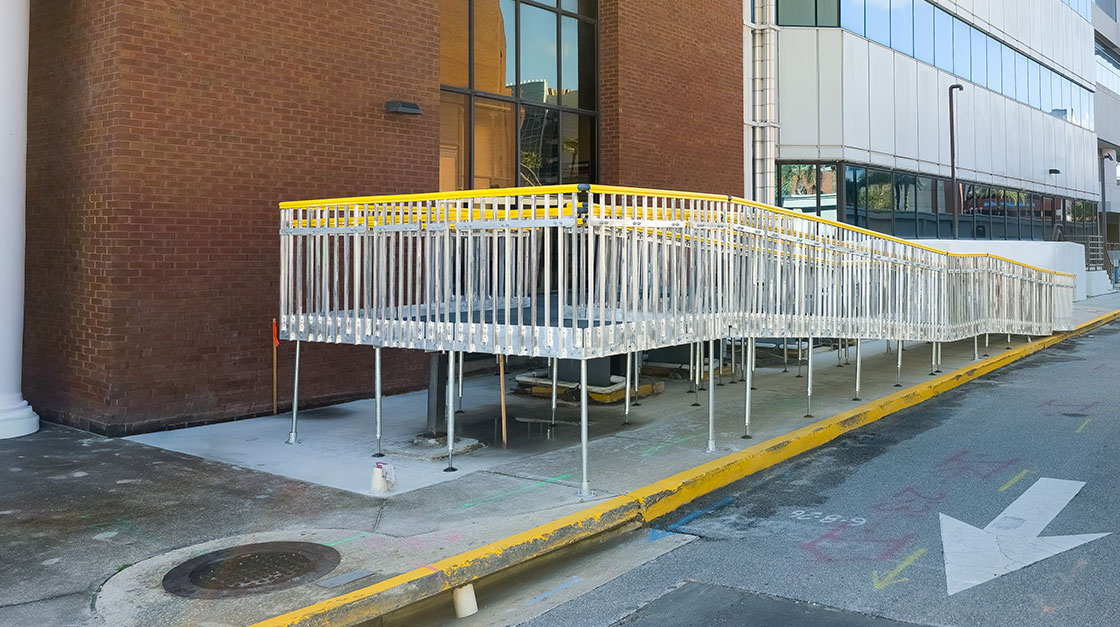
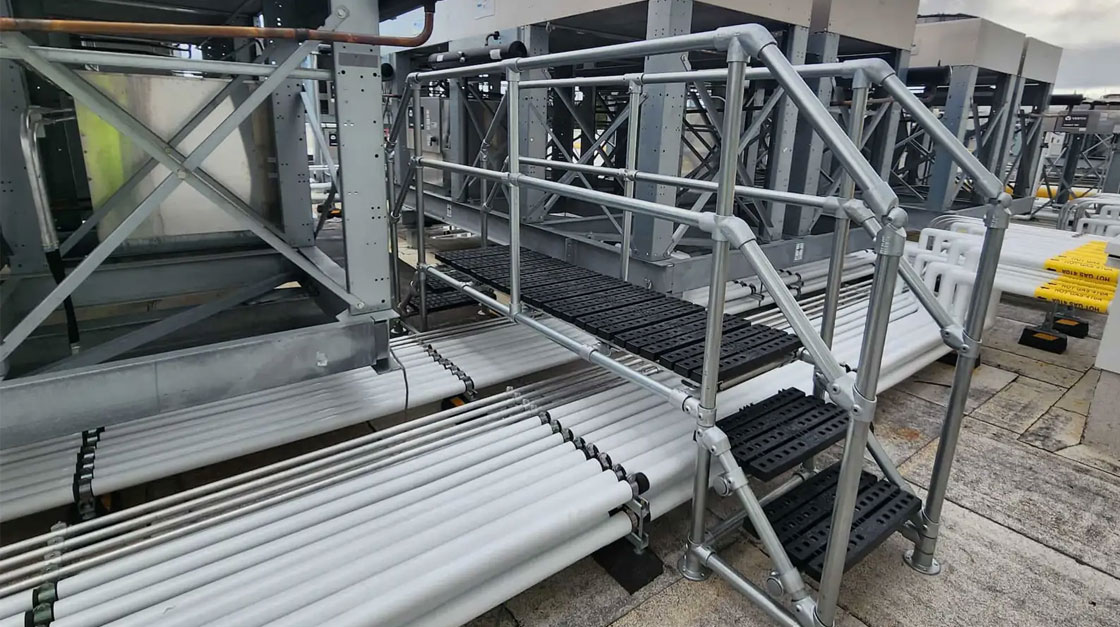
Permanent fixed access platforms create dedicated crossover bridges over active automated belt lines. Workers move seamlessly, avoiding rotating parts and pinch points as materials flow continuously.
Steep Ladders & Irregular Risers – When facilities save floor space by installing steep 60-degree ship stairs or narrow vertical ladders to reach elevated pick decks, it creates unnecessary strain for workers. Climbing a steep angle while holding an RF scanner forces awkward posture and speeds joint fatigue. Compliant stair towers with wide treads and predictable step spacing remove that strain from every trip.
Maintenance on Sorters & Scanners – Overhead sorter drives, scanner tunnels, and divert motors may break down or need belt-tensioning adjustments or other maintenance mid-shift. These tasks are often performed at heights above floor level but below any permanent mezzanine. Working from a narrow step ladder limits mobility and creates an unstable position.
- Roll-in mobile work platforms with heavy-duty, total-lock casters put the technician at motor height on a stable, ergonomic surface without gripping a ladder or other support.
Rapid Automation Reconfiguration
E-commerce footprints rarely stay static for more than two years. Expanded sortation lines, additional pick modules, and new automated storage and retrieval systems (ASRS) change the layout and maintenance access. Welded access stands turn into operational obstacles that require expensive demolition, hot-work permits, and line shutdowns. - Modular custom work platforms built from mechanical fittings are easily installed without welding or drilling. They can be adjusted to scale as the layout changes, without hot work permits or excessive downtime.

Engineering Ergonomics: Tread Physics, Riser Geometry and Anti-Bounce Performance
OSHA 29 CFR 1910.25 states that stairs must have a uniform riser height (9.5 inches max.) and uniform tread depth (9.5 inches min.) between landings. The reason is biomechanical. When every riser and tread is identical, muscle memory takes over, and workers move up and down quickly without worrying about each step. Even small variations force constant adjustments. Over thousands of steps per week, those adjustments add up to cumulative stress on the knees, hips, ankles, and lower back.
Deflection is the bending of a walking surface under load. Over long spans, lightweight bar grating flexes and vibrates with each stride, absorbing kinetic energy the worker must then replace. This “trampoline effect” forces leg muscles to work continuously to stabilize balance, which drains stamina across a full shift. Rigid systems built from strong, durable, corrosion-resistant aluminum alloy or hot-dipped galvanized steel with non-bounce treads eliminate dynamic deflection and vibration. A secure, stable surface channels a worker’s energy into efficient, fluid movement.
Fulfillment center floors collect cardboard dust, plastic stretch wrap fragments, packaging debris, and occasional fluid spills from equipment. Workers turn, start, and stop constantly like they are in a choreographed musical. Self-draining perforated aluminum or glass-reinforced nylon treads provide traction in every direction and let contaminants pass through.
Collective Safety Without Friction
OSHA 29 CFR 1910.28 requires fall protection wherever an unprotected edge is four feet or more above a lower level. Rapid, efficient material handling depends on uninterrupted, uninhibited movement. Manufacturing plants and construction sites often rely on “active” fall arrest for work-at-height tasks, but inspecting, clipping, and managing harnesses, lanyards, and tie-off points is inefficient and impractical in a fast-paced fulfillment center. These systems also require certified training, which can create staffing bottlenecks in high-turnover facilities.
Fall protection that does not rely on worker behavior must be built into the safety structure. Stair systems and work access platforms have guardrails that provide “passive” protection, safeguarding workers collectively, continuously, and effortlessly. OSHA 1910.29 sets the guardrail criteria, including:
- Top rail at 42 inches (+/-3 inches) above the walking-working surface.
- Mid-rails placed halfway between the top rail and the surface.
- Intermediate vertical members no more than 19 inches apart.
- Toe boards of at least 4 inches to prevent injuries from dropped scanners or other tools falling onto the level below.
- An automatic self-closing safety gate that protects workers at the opening.

Modular Engineered Access Ecosystem
The most effective facilities treat elevated access as a connected network instead of a collection of isolated structures.
Fixed Access Platforms – Fixed crossover bridges and multi-tier mezzanine stair systems form the backbone of facility-wide safety. They span high-speed conveyor lines, sorting chutes, and automated guided vehicle (AGV) travel lanes, creating uninterrupted pedestrian corridors and providing ergonomic access.
Mobile Work Platforms – Portable maintenance stands with heavy-duty total-lock casters can be positioned precisely for line-side servicing of elevated motors, diverter gates, and overhead mechanical equipment. They feature broad decks with built-in tool staging, allowing technicians to work with both hands.
Custom Work Platforms – Modular work access systems handle geometries standard dimensions cannot. They are tailored around unique conveyor curves, induction merges, spiral declines, and irregular building columns. Built with high-strength, pipe-fitted components, these systems install without on-site welding or drilling, so you can redeploy platforms when sorting lines reconfigure.
Trust a Single-Source Modular Engineering Supplier
As fulfillment operations push toward higher throughput and greater automation, access infrastructure must support both performance and workforce stamina. The strongest systems combine ergonomic stair geometry, rigid anti-bounce walking surfaces, passive fall protection, and modular adaptability.
FlexDecks specializes in ergonomic stair and platform systems that protect workers and boost productivity in high-volume fulfillment, distribution, and logistics facilities. The company provides:
- Application-specific engineering and 3D modeling for material handling environments.
- Load-rated, stamped modular components are fabricated from high-strength aluminum and galvanized steel that assemble with standard hand tools.
- Passive, collective fall protection systems that reduce liability while improving daily workforce stamina and operational throughput.
Facility directors and automation engineers can evaluate their pick modules, mezzanine access routes, and conveyor crossover layouts by visiting flexdecks.com or calling the access design team directly at (346) 998-5159.
Frequently Asked Questions
Q: Why do serpentine conveyor networks specifically increase fall and injury risk in fulfillment centers, and what infrastructure eliminates that risk?
A: Serpentine conveyor layouts divide the warehouse floor into isolated zones that workers must cross repeatedly to clear jams, verify barcodes, and reach adjacent aisles. When no designated crossing point exists, workers duck under belt runs or climb over equipment, exposing themselves to rotating parts, pinch points, and fall hazards from elevated belt structures without any fall protection. The behavioral pressure to take those shortcuts increases as throughput demands intensify during peak periods, which means the hazard compounds precisely when the facility is under the most operational stress. Permanent fixed crossover bridges spanning active belt lines create a designated, guardrail-protected pedestrian route that removes the shortcut decision entirely by making the compliant path the only available path.
Q: How does tread physics in fulfillment center stair systems affect worker productivity beyond the obvious safety implications?
A: OSHA’s riser and tread uniformity requirements exist because biomechanics research establishes that consistent step geometry allows muscle memory to govern stair movement without conscious cognitive involvement. A worker who has internalized the rhythm of a compliant stairway moves up and down quickly and efficiently, with minimal energy expenditure per trip. A worker navigating irregular risers or steep 60-degree ship stairs must consciously manage each step, which consumes cognitive bandwidth, slows the traverse, and taxes the same joints repeatedly in ways that produce cumulative musculoskeletal stress over a career. In a facility where a single worker may make 50 or more mezzanine trips per shift, that energy efficiency difference per trip compounds into meaningful differences in end-of-shift stamina, error rates, and long-term injury exposure.
Q: What makes modular pipe-fitted platforms specifically suited to e-commerce facilities that reconfigure their layouts every two years or less?
A: Welded access platforms are permanent structures that serve one layout configuration. When a sorting line expands, a new ASRS is added, or pick module positions shift, a welded stand either stays in the wrong position or requires hot work permits, a shutdown of the surrounding area, and demolition labor to remove it. Neither outcome is acceptable in a facility that may be reconfiguring under live operational pressure. Pipe-fitted modular platforms use mechanical fittings that connect and disconnect with hand tools, which means the same components that served the previous layout can be disassembled, reconfigured, and reinstalled in the new one without generating sparks near automated equipment, without requiring specialized trades, and without taking the surrounding operation offline. The platform budget becomes a capital asset that follows the facility rather than a sunk cost that the facility outgrows.
Q: Why is passive collective fall protection the only practical compliance model for fulfillment centers with high workforce turnover and seasonal staffing fluctuations?
A: Active fall protection systems require workers to understand the equipment, inspect it before each use, don it correctly, identify rated anchor points, and maintain awareness of their connection throughout the task. Building that capability requires certified training that takes time and must be repeated as the workforce turns over. During peak season hiring, when a facility may onboard hundreds of temporary workers in a compressed window, delivering that training reliably across the entire workforce before those workers begin accessing elevated areas is operationally difficult to guarantee. Passive guardrail systems built into stair towers, crossover platforms, and mezzanine edges provide the same protection on day one of employment as they do after months of tenure, without requiring any training specific to the fall protection system. That independence from individual training and behavioral compliance is what makes passive protection the only model that performs consistently across the workforce composition that fulfillment operations actually have rather than the idealized stable workforce that active systems assume.