Install Once, Inspect Never: Eliminating the Hidden Truck-Roll Tax in Off-Grid Energy Utilities
Remote wind farms, solar fields, substations, and battery storage sites sit far from the nearest depot, which turns routine structural upkeep into a truck-roll tax of vehicles, materials, and labor hours that rarely appears in a budget. Treated wood rots and burns, and painted carbon steel cracks, rusts, and needs hot work permits to repair. Pre-engineered aluminum and steel platforms, stairs, and ramps with self-draining, non-slip treads assemble with hand tools, meet OSHA and IBC/ADA requirements, and stay sound for decades without field painting or welding.
Key Takeaways
- Conventional materials drive the truck-roll tax. Treated wood warps, rots, and is a fire hazard in a dry substation yard, while welded carbon steel depends on a coating that UV exposure cracks, letting corrosion start at the weld points. Aluminum forms a self-healing oxide film, so its corrosion resistance does not depend on a coating.
- Three access types cover most utility yard needs: work platforms for transformers, tap changers, and switchgear, steps and crossover bridges for trench covers and containment dikes, and modular ramps for control houses and battery enclosures. Each assembles with mechanical fasteners and basic hand tools, so no hot work permit or fire watch is required.
- Lifecycle cost favors aluminum. A low-bid installation that needs recoating about every three years means roughly eight maintenance sequences over a 25-year plant life, each with mobilization, surface prep, coating, and follow-up inspection. An aluminum modular system needs little more than an occasional visual inspection.

Install Once, Inspect Never: Eliminating the Hidden Truck-Roll Tax in Off-Grid Energy Utilities
Fuhgeddaboudit! From its New York City origins in Italian American communities to its pop-culture use by Oscar the Grouch on Sesame Street and Jonny Depp as “Donnie Brasco,” fuhgeddaboudit has evolved from a coping mechanism to mean “don’t worry.”
Maintenance directors of remote power generation stations may “forget about it” because of another old saying: “out of sight, out of mind.” Unless there is an emergency, sending crews on a long hike to do minor scraping, grinding, or painting of platforms, walkways, and ramps seems like a waste of time and money.
But if an outage or other problem occurs, the substation access infrastructure must be safe and compliant. Technicians should not worry about a slip and fall when they need to focus on restoring power. By deploying pre-engineered, corrosion-resistant aluminum assemblies with self-draining, omnidirectional, non-slip treads, operators do not have to worry about OSHA and IBC/ADA compliance. These safe access systems outperform conventional materials and endure decades of punishing conditions in remote environments, with no field painting or welding required.
The Harsh Realities of Remote Power Generation
Modern power generation is often located where the resources are, but where the people are not. Wind farms stretch across isolated plains and offshore, along saltwater corridors. Solar fields spread through arid deserts with brutal day-to-night temperature swings. Remote substations and battery energy storage systems (BESS) sit miles from the nearest regional depot. The fuel itself costs nothing, but access is expensive.
This is the “truck-roll tax,” an unbudgeted line item that suddenly appears when crews must mobilize for structural upkeep, like fixing a wobbly wooden landing, touching up rusted welds, and cleaning oil-soaked steps. Service vehicles, replacement materials, and labor hours add up in thousands of dollars, with a multiplying drain on productivity.
The goal is not to make this structural maintenance cheaper. The goal is to build access infrastructure that outlasts the equipment it serves and stays sound for decades without field painting, welding, or repair.
Material Vulnerabilities in Utility Environments
The maintenance breakdowns are typically the result of using conventional materials that fail in remote environments.
Treated Wood: Inexpensive and easy to work with, but it warps, splits, and rots in desert heat. It also attracts termites. In a dry substation yard, a combustible wood landing is an extreme fire hazard.
Welded Carbon Steel: Strong, but it needs protective coats of paint. UV exposure cracks the coating. Water seeps into microscopic fissures at the weld points. Corrosion weakens the entire structure. Restoration means sandblasting, repairing the assembly, and recoating. Patching requires hot work permits for welding, which can spark a blaze.
Engineered Aluminum Changes the Material Equation:
- Aluminum’s natural passivation forms a self-healing oxide film that reforms when scratched.
- Its corrosion resistance does not depend on a vulnerable coating, and it withstands salt spray and harsh chemicals.
- Its strength-to-weight ratio also lets crews build modular assemblies in remote locations without bringing in heavy equipment or cranes.
Solving the Utility Work-at-Height and Transit Puzzle
Power generation facilities rely on three kinds of infrastructure access to ensure efficient workflows:
#1 Work Platforms – for servicing transformer radiators, tap changers, capacitor banks, and gas-insulated switchgear (GIS).
Modular systems with integrated guardrails, built from standard components, install quickly and efficiently without welding or drilling. They create stable, ergonomic walking-working surfaces that can expand or be reconfigured as yards change. Platforms feature anti-slip, non-bounce, omnidirectional treads that are also self-draining to shed snow, rain, and mud.
- Static (fixed) platforms are ideal for permanent placement where frequent access is needed.
- Mobile platforms feature heavy-duty, total-lock casters for station-to-station portability.
- Custom-engineered platforms “hug” complex equipment profiles without interfering with grounding grids. They give technicians a comfortable, ergonomic workspace without an unsafe gap between the platform and the equipment being serviced.
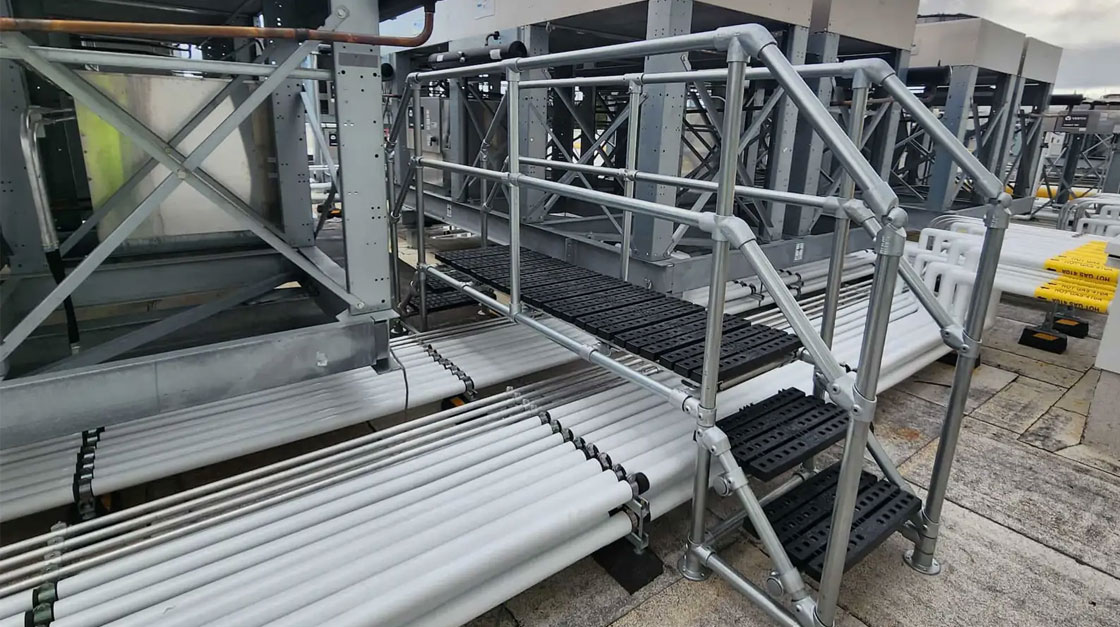
# 2 Steps & Crossover Platforms – for stepping over high-voltage trench covers, secondary oil containment dikes, and ground conduit networks.
Many yard injuries happen during improvised, everyday movement, when workers climb or try to hop over obstacles and balance on fragile conduits. Anti-slip, self-draining stair systems and crossover bridges provide safe, guided routes across the yard while protecting the integrity of the utility’s assets.
- Stair systems can be simple stepovers, fixed units, mobile systems, or custom-engineered.
- Crossover bridges adapt to the specific site requirements to span obstructions or overcome a change in the surface levels.
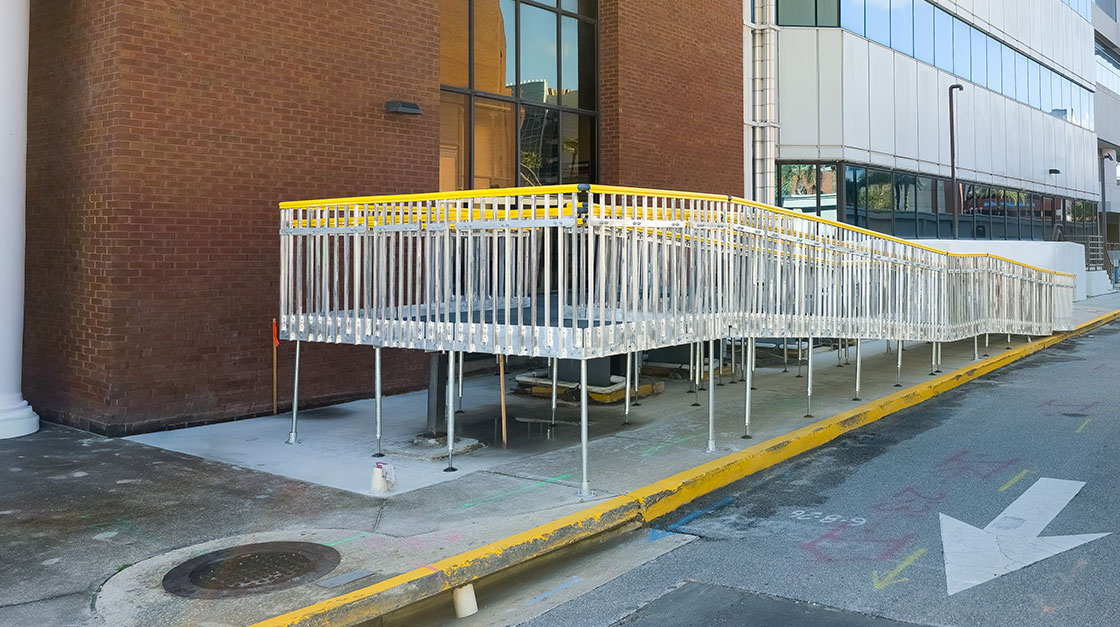
#3 Industrial Ramps – provide access to prefabricated control houses, relay rooms, and BESS enclosures.
When technicians must move diagnostic equipment, oil barrels, gang boxes, carts, etc., modular ramp systems can be installed quickly and easily with only hand tools. Featuring anti-slip, self-draining surfaces, they provide smooth, efficient transit and avoid the time and cost of poured concrete ramps. And unlike concrete, they can be reconfigured.
No Hot Work, No Heavy Equipment for Fast Field Deployment
Substation and BESS yards have strict fire-safety and work-authorization rules. Open-flame welding means hot-work permits, station fire watches, and potential outage scheduling.
FlexDecks modular platforms, stairs, and ramps assemble with mechanical fasteners and basic hand tools. No field welding or coating applications are needed. Palletized components can arrive by standard utility pickup or flatbed trucks. A small crew can often assemble access systems in hours rather than days.
Efficient assembly and minimal maintenance—especially compared to conventional materials—mean greater productivity for workers at these remote sites.
The Governing Regulatory & Safety Standards
Easy-to-install, durable systems must first meet strict safety and building codes:
- OSHA 29 CFR 1910.25 covers walking-working surfaces, including stairways, specifying uniform riser heights and tread depths, step and platform widths, angles (30 to 50 degrees for stairs; less than 30 degrees for ramps), vertical clearances, and other requirements.
- OSHA 29 CFR 1910.28 establishes the duty to provide fall protection on walking-working surfaces—with protection against falling objects—at heights of 4 feet or more for general industry.
- OSHA 29 CFR 1910.29 sets criteria for guardrail systems, including a top rail height of 42 (+/- 3 inches), mid-rails, toe boards, and the ability to withstand a 200 lb. force applied anywhere along the top rail.
- International Building Code (IBC) and the Americans with Disabilities Act (ADA) standards for accessible design govern ramp slopes (1:12 maximum), landing dimensions, and continuous handrail extensions on personal control shelters and public utility interfaces.
Lifecycle ROI: The True Economics of “Set and Forget”
Purchase price tells only part of the story. Consider a low-bid painted steel installation that needs recoating and bolt replacement roughly every three years. That adds up to eight sequences over a 25-year plant lifecycle. Each intervention means mobilization, surface prep, coating, cure time, and a follow-up inspection. An aluminum modular system avoids nearly all of that, requiring only an occasional visual inspection. No painting, welding, or rust remediation.
The safety aspect is also paramount. Consistent step geometry, stable platforms, and aggressive non-slip decking reduce the sprains, strains, and falls that add up in lost-time injuries. A single fall from a conduit or slip on an oil-soaked landing can cost more in workers’ compensation, investigation, and operational disruption than an aluminum system.
Install once. Inspect as required. Forget about a continuous cycle of rolling trucks and structural repairs.
Contact FlexDecks today for an engineering review of how modular aluminum work access systems with anti-slip surfaces can boost safety and efficiency for your remote utility site while decreasing lifecycle costs.
Frequently Asked Questions
Q: What is the truck-roll tax, and why does it matter for remote energy sites?
A: The truck-roll tax is the unbudgeted cost of sending crews to a remote site for structural upkeep such as fixing a wobbly wooden landing, touching up rusted welds, or cleaning oil-soaked steps. Service vehicles, replacement materials, and labor hours add up to thousands of dollars per trip, and the crew’s time is also unavailable for work that actually supports generation. At sites located miles from a regional depot, even minor repairs carry that overhead. The practical goal is not cheaper structural maintenance but access infrastructure that outlasts the equipment it serves and needs little or no repair.
Q: Why do treated wood and welded carbon steel fail in remote utility environments?
A: Treated wood warps, splits, and rots in desert heat, attracts termites, and is combustible, which makes a wooden landing an extreme fire hazard in a dry substation yard. Welded carbon steel is strong but relies on protective paint. UV exposure cracks the coating, and water seeps into microscopic fissures at the weld points, where corrosion then weakens the whole assembly. Restoration means sandblasting, repair, and recoating, and patching requires hot work permits for welding, which can itself spark a fire. Aluminum avoids both failure modes because its protection is a self-healing oxide film rather than an applied layer.
Q: Which OSHA standards govern platforms, stairs, and guardrails in a substation or energy yard?
A: Three standards do most of the work. OSHA 29 CFR 1910.25 covers stairways and sets requirements for uniform riser heights and tread depths, widths, angles, and clearances. OSHA 29 CFR 1910.28 establishes the duty to provide fall protection on walking-working surfaces at heights of four feet or more in general industry, including protection against falling objects. OSHA 29 CFR 1910.29 sets guardrail criteria, including a top rail height of 42 inches, plus or minus three, mid-rails, toe boards, and the ability to withstand a 200-pound force applied anywhere along the top rail. Ramps serving control houses and similar shelters are also governed by IBC and ADA accessibility provisions, including a maximum 1:12 slope, landing dimensions, and continuous handrail extensions.
Q: How does a modular system handle the fire and permitting constraints of a substation or battery storage yard?
A: Substation and battery storage yards operate under strict fire-safety and work-authorization rules, and open-flame welding triggers hot work permits, station fire watches, and possibly outage scheduling. Modular platforms, stairs, and ramps assemble with mechanical fasteners and basic hand tools, with no field welding or coating application. Palletized components can arrive by standard utility pickup or flatbed truck, and a small crew can often finish an access system in hours rather than days. That removes the permitting and scheduling burden from the installation, and the same is true later when the layout of the yard changes and the components need to be reconfigured.